XRP Ledger Activates Token Escrow: Here’s What XLS-85 Unlocks

bitcoinistPublished on 2026-02-13Last updated on 2026-02-13

Abstract

The XRP Ledger has activated the Token Escrow (XLS-85) amendment on its mainnet, extending its native escrow functionality beyond XRP to include Trustline-based tokens (IOUs) and Multi-Purpose Tokens (MPTs). This enables secure, conditional, on-chain settlements for assets like stablecoins and real-world assets. The feature requires specific issuer flags for tokens to be escrowed and includes authorization rules for secure transactions. It supports time-based, conditional, and combination escrows, though it involves transaction fees and requires an expiration time for token escrows. Use cases include vesting, conditional payments, treasury workflows, and tokenized rights, providing a native "lock until X" mechanism without relying on third-party custodians.

The XRP Ledger has activated Token Escrow (XLS-85) on mainnet on Feb.12, extending the network’s native escrow mechanics beyond XRP to Trustline-based tokens (IOUs) and Multi-Purpose Tokens (MPTs). The amendment was enabled today with 88% consensus (30/34 validators) and was introduced in rippled v2.5.0 under the XLS-85 specification.

Escrow, But For Every Asset On XRP Ledger

RippleX framed the change as a broadening of XRPL’s settlement primitives from one native asset to the wider token stack via X:

“Token Escrow (XLS-85) is now live on XRPL Mainnet! This feature extends native escrow functionality beyond XRP to all Trustline-based tokens (IOUs) and Multi-Purpose Tokens (MPTs). From stablecoins like RLUSD to Real World Assets, the XRPL now supports secure, conditional, onchain settlement for all assets.” It added: “The toolbox for Institutional DeFi just got bigger.”

XRPL.org describes escrow in familiar terms, then emphasizes what the ledger automates: “Traditionally, an escrow is a contract between two parties to facilitate financial transactions... The XRP Ledger takes escrow a step further, replacing the third party with an automated system built into the ledger.” With the TokenEscrow amendment, that same approach now applies to fungible tokens, not just XRP.

For Trust Line Tokens, the issuing account must enable the Allow Trust Line Locking flag so the issued token can be escrowed. For MPTs, the issuer must set Can Escrow and Can Transfer flags at issuance so those tokens can both be held in escrow and transferred when released. One notable constraint: issuers cannot create escrows using their own issued tokens, though they can receive escrowed tokens as recipients.

Authorization gating also matters. If a token requires authorization, the sender must be pre-authorized by the issuer before creating an escrow, and must be authorized to receive the tokens back if an expired escrow is canceled—regardless of who submits the cancellation. Separately, the recipient must be pre-authorized before an escrow can be finished.

XRPL supports time-based, conditional, and combination escrows. The flow is anchored around EscrowCreate to lock funds, EscrowFinish to release them when conditions are met, and EscrowCancel to return funds once an escrow expires. For token escrows specifically, an expiration time is mandatory.

The feature is not free. XRPL.org flags that escrow “requires two transactions” and that Crypto-Conditions increase fees. While the ledger supports Crypto-Conditions, it currently only supports PREIMAGE-SHA-256, and fulfillment verification raises EscrowFinish costs. The documentation gives a concrete minimum: an EscrowFinish with a fulfillment requires at least 330 drops of XRP plus an additional amount based on fulfillment size, with the formula scaling if fee settings change.

RippleX highlighted use cases spanning vesting and grants, conditional payments and OTC-style swaps, treasury workflows like legal holds and collateral, and tokenized rights and RWA-style unlocks. The common thread is a native, on-ledger “lock until X” mechanism now available to the token layer, useful for structured settlement, compliance-shaped flows, and predictable release conditions without relying on a third-party custodian or purely off-chain coordination.

At press time, XRP traded at $1.35.
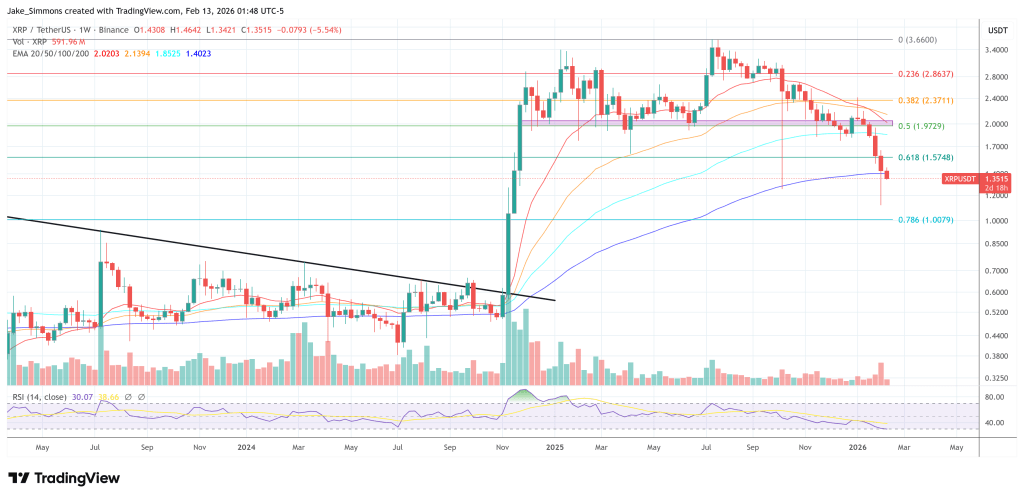
XRP drops below the 200-week EMA, 1-week chart | Source: XRPUSDT on TradingView.com

Related Questions

QWhat is the main feature activated on the XRP Ledger mainnet on February 12, as described in the article?

AThe main feature activated is Token Escrow (XLS-85), which extends the network's native escrow functionality beyond XRP to include Trustline-based tokens (IOUs) and Multi-Purpose Tokens (MPTs).

QAccording to the article, what are the two types of tokens that the new Token Escrow feature now supports?

AThe Token Escrow feature now supports Trustline-based tokens (IOUs) and Multi-Purpose Tokens (MPTs).

QWhat specific flags must an issuer set for a Multi-Purpose Token (MPT) to be eligible for escrow?

AFor an MPT to be eligible for escrow, the issuer must set the Can Escrow and Can Transfer flags at the time of issuance.

QWhat are the three primary transaction types involved in the XRPL escrow flow?

AThe three primary transaction types are EscrowCreate (to lock funds), EscrowFinish (to release funds when conditions are met), and EscrowCancel (to return funds once an escrow expires).

QBesides time-based escrows, what other types of escrow does the XRPL support, as mentioned in the article?

ABesides time-based escrows, the XRPL also supports conditional escrows and combination escrows.

Related Reads

Musk's New Plan: Building an AI Base on the Moon, More Appealing Than Mars Colonization?

Elon Musk is shifting his strategic focus from colonizing Mars to establishing an AI base on the Moon, according to an internal presentation to employees following the merger of SpaceX and xAI. This new vision, dubbed "Lunar Base Alpha," involves building a city on the Moon and using mass drivers to launch AI satellites into deep space. The initiative is positioned as both a new recruitment tool and a unique value proposition for the merged entity, aiming to attract talent and capital by offering an ambitious alternative to conventional Earth-based AI development. Musk argues that achieving computational power exceeding one terawatt annually requires leveraging solar energy available on the Moon. This pivot aligns with SpaceX’s recent move away from its long-term Mars colonization goal, which lacks clear commercial funding, toward more immediately profitable ventures like Starlink satellite launches and NASA’s lunar missions. The Moon base narrative also serves to reinvigorate engineering enthusiasm by framing the project within the theoretical framework of the Kardashev Scale—suggesting that advanced civilizations harness stellar energy through space-based infrastructure. While technically and economically speculative, the momentums reflects a strategy to differentiate xAI from other AI labs, potentially boosting market expectations ahead of a possible IPO and appealing to retail investors.

比推1h ago

Musk's New Plan: Building an AI Base on the Moon, More Appealing Than Mars Colonization?

比推1h ago

Trading

Spot
Futures

Hot Articles

How to Buy XRP

Welcome to HTX.com! We've made purchasing XRP (XRP) simple and convenient. Follow our step-by-step guide to embark on your crypto journey.Step 1: Create Your HTX AccountUse your email or phone number to sign up for a free account on HTX. Experience a hassle-free registration journey and unlock all features.Get My AccountStep 2: Go to Buy Crypto and Choose Your Payment MethodCredit/Debit Card: Use your Visa or Mastercard to buy XRP (XRP) instantly.Balance: Use funds from your HTX account balance to trade seamlessly.Third Parties: We've added popular payment methods such as Google Pay and Apple Pay to enhance convenience.P2P: Trade directly with other users on HTX.Over-the-Counter (OTC): We offer tailor-made services and competitive exchange rates for traders.Step 3: Store Your XRP (XRP)After purchasing your XRP (XRP), store it in your HTX account. Alternatively, you can send it elsewhere via blockchain transfer or use it to trade other cryptocurrencies.Step 4: Trade XRP (XRP)Easily trade XRP (XRP) on HTX's spot market. Simply access your account, select your trading pair, execute your trades, and monitor in real-time. We offer a user-friendly experience for both beginners and seasoned traders.

12.3k Total ViewsPublished 2024.03.29Updated 2025.03.21

What is XRP 2.0

XRP 2.0: A New Frontier in the Cryptocurrency Landscape Introduction to XRP 2.0 In the ever-evolving realm of cryptocurrency, new projects continuously emerge, vying for attention and adoption. One such promising initiative is XRP 2.0, a novel cryptocurrency project designed to leverage advanced blockchain technology and robust encryption methodologies. While the name draws parallels with Ripple’s XRP, it’s crucial to note that XRP 2.0 operates independently, focusing on enhancing transaction security, privacy, and scalability. As the digital financial landscape increasingly embraces decentralized solutions, XRP 2.0 aims to contribute meaningfully to web3 and the overall expansion of crypto projects. What is XRP 2.0? At its core, XRP 2.0 is a cryptocurrency project that aims to create a secure and decentralized digital currency ecosystem. Its foundational technology integrates sophisticated blockchain principles with cutting-edge encryption techniques. The overarching goal of XRP 2.0 is to establish itself as a reliable and efficient platform enabling swift transaction execution while prioritizing enhanced privacy protections for its users. The project is promoted as a solution to many limitations faced by existing cryptocurrencies, proposing a system that can handle a higher volume of transactions with improved speed and privacy. This versatility positions XRP 2.0 as a significant contender in a marketplace riddled with various digital currencies. Who is the Creator of XRP 2.0? The identity of the creator behind XRP 2.0 has been flagged as ‘Wilbur.’ However, comprehensive details regarding Wilbur or their associated entity remain elusive. The anonymity of many cryptocurrency creators is not an uncommon phenomenon in the industry, often designed to maintain a degree of privacy and security. Who are the Investors of XRP 2.0? As of now, specific information related to the investment foundations or organizations supporting XRP 2.0 is not publicly available. In the cryptocurrency sector, the backing by reputed investors can significantly influence a project's credibility and success, yet the transparency regarding the financial supporters of XRP 2.0 has not been established. How Does XRP 2.0 Work? XRP 2.0 stands out by employing a combination of blockchain technology and advanced encryption algorithms that ensures secure and decentralized transactions. Its innovative structure includes unique features designed to foster user engagement and broaden functionalities beyond conventional cryptocurrency transactions. Among these features, XRP 2.0 incorporates AI-powered capabilities, such as text-to-image and text-to-speech functionalities. These additions are designed to enhance the interactive experience for users, promoting broader applicability across various sectors. By bridging technological advancements with user-centered design, XRP 2.0 aims to capture the attention of a diverse range of individuals and enterprises looking to integrate cryptocurrency solutions into their operational frameworks. Timeline of XRP 2.0 Understanding XRP 2.0 requires examining the milestones that have defined its journey thus far: July 23, 2023: XRP 2.0 is introduced as a novel cryptocurrency project, aiming to revolutionize secure and decentralized transaction capabilities in the blockchain domain. September 8, 2023: The launching of another project, XRP20, occurs, marking the emergence of an ERC-20 token on the Ethereum blockchain that remains unrelated to XRP 2.0. November 13, 2023: The XRP Ledger undergoes a significant update with the release of rippled server software version 2.0.0. It is essential to note that this development is disconnected from the XRP 2.0 cryptocurrency project. Key Points About XRP 2.0 To distill the essence of XRP 2.0, several critical factors emerge: Unique Features: The inclusion of features like AI-powered text-to-image and text-to-speech further diversifies the potential applications of XRP 2.0. Blockchain Technology: The framework utilizes advanced blockchain mechanisms and encryption protocols, ensuring a secure and decentralized environment for transactions. Scalability and Privacy: XRP 2.0 prioritizes enhanced privacy protections in transaction processes and the scalability necessary to accommodate a growing user base. No Affiliation with Ripple: Importantly, despite its name, XRP 2.0 does not have any allegiance or collaboration with Ripple’s XRP, distinguishing its operational framework and objectives within the cryptocurrency ecosystem. Conclusion XRP 2.0 represents an ambitious venture into the cryptocurrency sphere, aiming to offer a combination of security, privacy, and efficiency in digital transactions. By integrating sophisticated technologies and user-friendly features, the project sets out to broaden the horizons of what cryptocurrency can achieve in today's digital economy. While the anonymity of its creator and lack of disclosed investors might raise questions for some, XRP 2.0's focus on advanced functionalities and decentralisation enhances its appeal amidst an increasingly crowded crypto market. As the cryptocurrency landscape continues to evolve, XRP 2.0 may yet emerge as a pivotal player in the expansion of secure and scalable blockchain solutions.

941 Total ViewsPublished 2024.04.01Updated 2024.12.03

Discussions

Welcome to the HTX Community. Here, you can stay informed about the latest platform developments and gain access to professional market insights. Users' opinions on the price of XRP (XRP) are presented below.

活动图片